
Manual Testing: Benefits, Limitations, and When It Breaks Down
Most software teams begin their testing journey with manual testing. It is the most accessible way to validate a product, requires minimal setup, and allows teams to quickly verify functionality as features are built.
Even today, manual testing remains a critical part of the QA process. But as products grow and release cycles accelerate, teams begin to feel its limitations.
This is where the conversation around testing starts to change.
Why manual testing still matters
Manual testing plays a role that cannot be fully replaced.
It allows testers to think critically, explore edge cases, and evaluate the product from a real user’s perspective. This becomes especially valuable when requirements are evolving or when the focus is on usability rather than strict validation.
Exploratory testing, in particular, depends on human intuition. Testers often catch issues that predefined scripts miss, such as confusing flows, unclear messaging, or unexpected behavior during real usage.
For early-stage products or rapidly changing features, manual testing provides the flexibility teams need to move quickly without being constrained by rigid processes.
Where manual testing works well
There are clear scenarios where manual testing is not just sufficient, but ideal:
- Small teams with limited resources
- Products in early development stages
- Features that change frequently
- Low release frequency
- Testing that requires human judgment (UI/UX, exploratory testing)
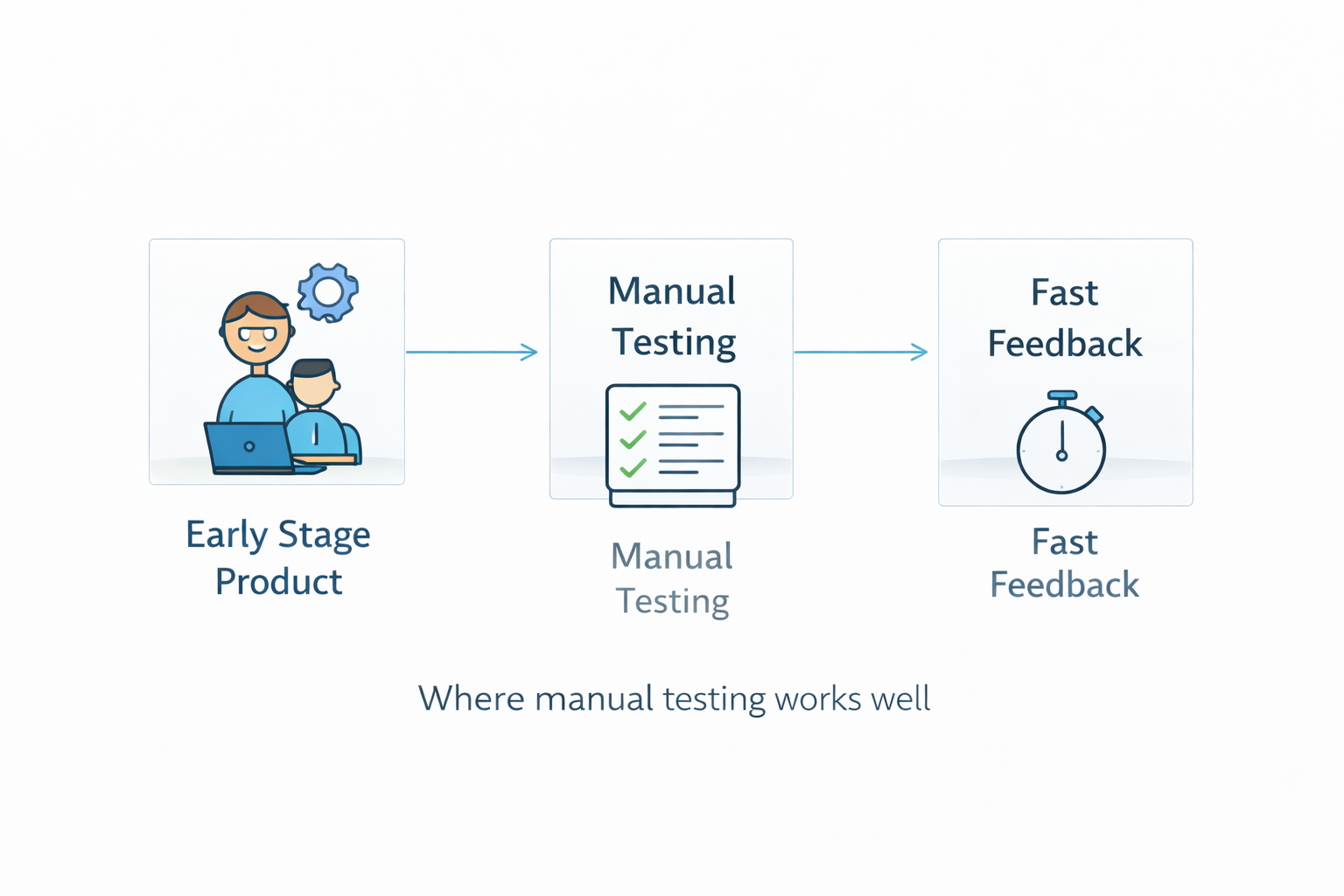
In these situations, the overhead of automation often outweighs its benefits. Manual testing keeps teams focused on building and iterating rather than maintaining test infrastructure.
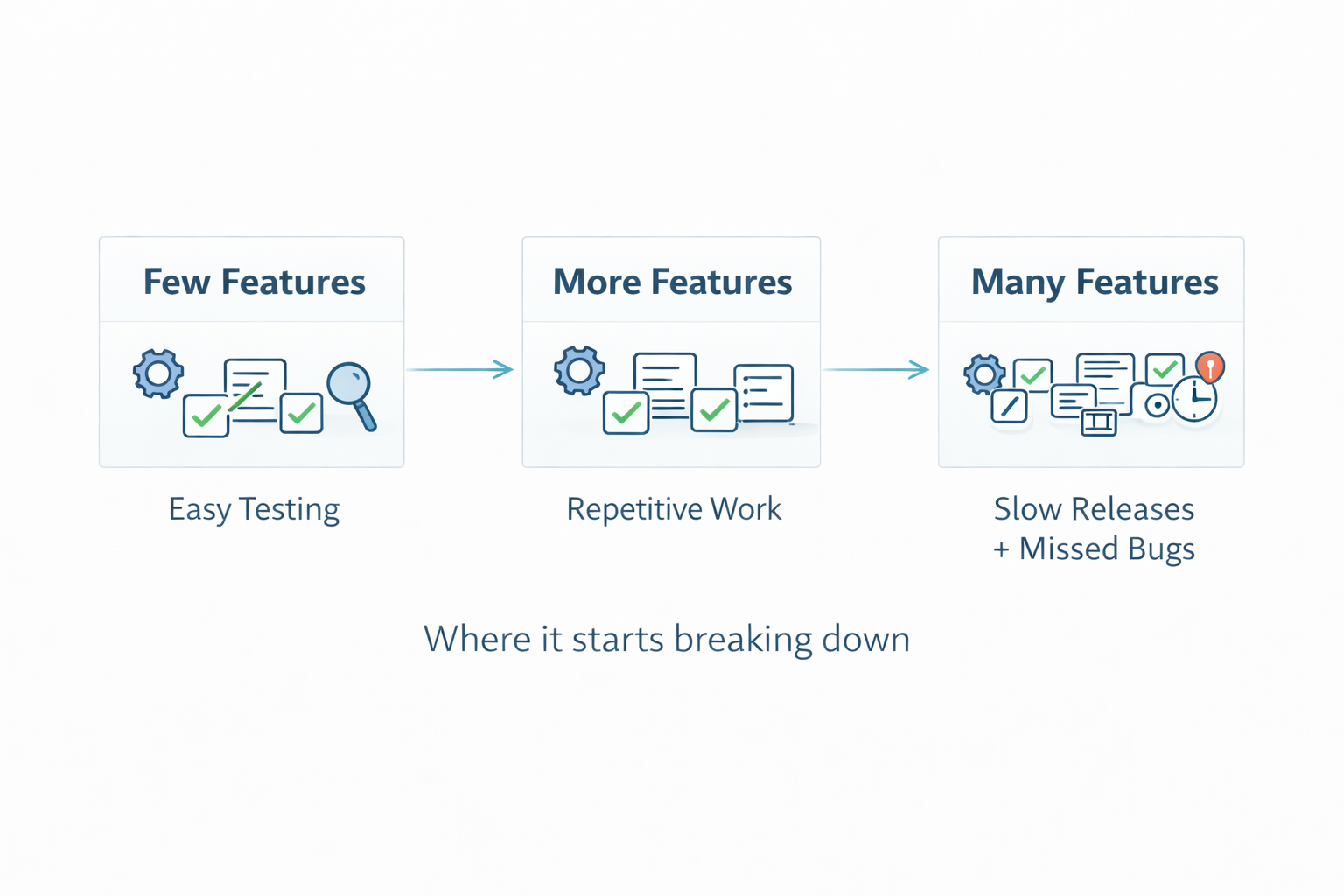
Where it starts breaking down
As the product matures, the nature of testing begins to change.
New features are added, existing ones evolve, and the number of possible user flows increases. What was once manageable manually starts to become repetitive and time-consuming.
Regression testing becomes the biggest challenge. Every release requires re-validating previously working functionality, and this effort grows with every new feature.
Over time, teams start experiencing:
- Increasing time spent on repetitive test cycles
- Higher chances of human error
- Inconsistent test coverage across releases
- Delays in release timelines due to testing bottlenecks
Key signals that manual testing is no longer enough
- Regression cycles are taking too long
- Releases are delayed due to incomplete testing
- Bugs are reaching production despite testing effort
- Test coverage depends heavily on individual testers
These are early indicators that the current approach is not scaling with the product.
The hidden cost of staying fully manual
The impact of manual testing at scale is not always obvious at first.
It shows up gradually in slower release cycles, reduced confidence in deployments, and increasing pressure on QA teams. Testers spend more time repeating the same scenarios instead of focusing on meaningful, high-value testing.
There is also a growing dependency on individuals. Since execution is manual, consistency depends on who performs the tests and how thoroughly they follow the process.
As systems become more complex, maintaining reliability through manual effort alone becomes increasingly difficult.
Why teams start looking toward automation
At this stage, many teams begin exploring automation.
The goal is not to replace manual testing, but to reduce the burden of repetitive work. Automation helps teams run regression tests faster, improve consistency, and scale testing alongside product growth.
This is where traditional tools like Selenium became widely adopted. They offered a way to programmatically test applications and reduce manual effort.
However, automation introduces its own challenges, particularly around setup, maintenance, and long-term reliability.
Conclusion
Manual testing remains an essential part of any QA strategy. It brings flexibility, insight, and a human perspective that automation cannot fully replicate.
But as products scale, relying entirely on manual testing creates friction that slows teams down.
This is why many teams transition toward automation. The next step often involves tools like Selenium, which have shaped modern test automation, but also come with their own complexities.
In the next article, we will explore how traditional test automation works, why it became the standard, and where it starts to fall short for growing teams.