
Why Test Automation Becomes Hard to Maintain Over Time
Test automation is often seen as a one-time investment. Write tests once, and they keep validating your product as it evolves. In reality, automation is not “write once and forget.” It is a system that requires continuous effort to keep it working.
As products grow, maintaining test automation becomes one of the biggest challenges for QA teams.
The hidden assumption about automation
When teams start automation, they assume:
- Tests will run automatically
- Maintenance effort will be minimal
- Adding more tests will improve coverage without much cost
But over time, the reality looks different:
- Tests need constant updates
- Maintenance effort keeps increasing
- Scaling automation becomes slower
Automation is not static
Unlike code, test automation is tightly linked to how the application behaves.
Every change in the product affects tests.
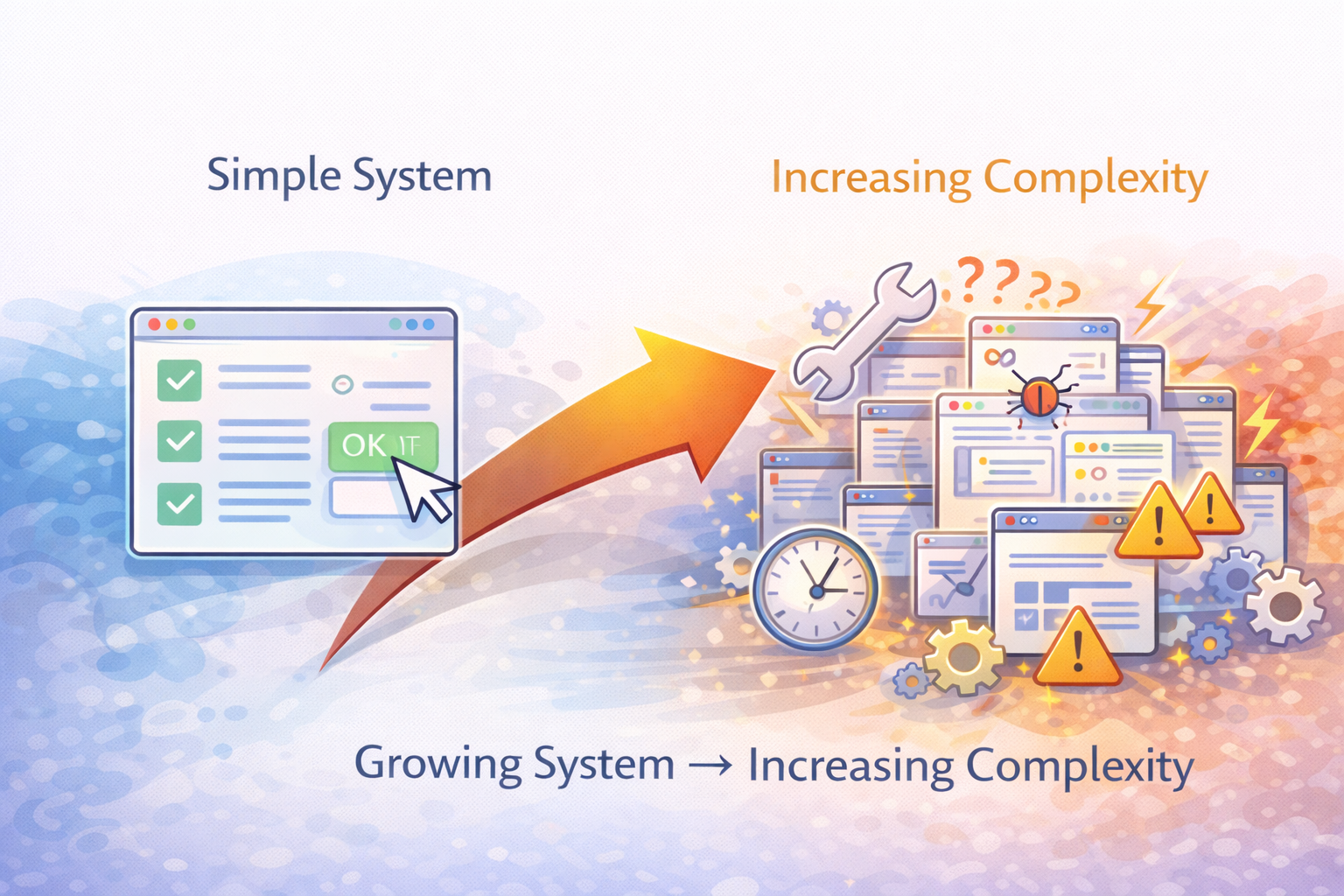
1. Every product change creates test updates
Applications evolve continuously:
- UI redesigns
- Workflow changes
- New validations
Each change requires updates in:
- Test steps
- Locators
- Expected outcomes
Even small UI updates can trigger multiple test changes.
2. Test suites grow faster than expected
At the beginning:
- A few tests cover key flows
Over time:
- More features → more test cases
- Edge cases → additional coverage
- Regression → larger suites
Growth pattern
Initial → 20 tests
After few releases → 100 tests
At scale → 500+ tests
Each additional test increases:
- Execution time
- Debugging effort
- Maintenance overhead
3. Maintenance work compounds
Maintenance is not linear.
It compounds as:
- More tests depend on shared components
- Changes affect multiple test cases
- Fixing one issue impacts others
This creates a cycle:
Change → Break tests → Fix tests → New issues appear
4. Test code becomes harder to manage
Over time, test suites become:
- Large
- Complex
- Difficult to debug
Common issues:
- Duplicate logic
- Inconsistent patterns
- Hard-to-read test flows
This makes updates slower and riskier.
5. Execution time becomes a bottleneck
As test suites grow:
- Test runs take longer
- CI pipelines slow down
- Feedback cycles increase
Teams start:
- Skipping tests
- Running partial suites
- Delaying execution
Which reduces the value of automation.
Common signs of high maintenance cost
You will notice:
- Adding a new test takes too long
- Small changes break multiple tests
- Debugging takes more time than writing tests
- Test runs slow down significantly
- Teams hesitate to expand coverage
Why this problem keeps growing
Even with best practices, the core issue remains:
Automation depends heavily on:
- UI structure
- application behavior
- test code design
As all of these evolve, maintenance effort increases.
Summary of the real problem
Why teams rethink automation strategy
At some point, teams realize:
- Automation is not failing
- It is becoming expensive to maintain
This leads to a shift:
From:
“How do we write more tests?”
To:
“How do we reduce maintenance effort?”
A better direction
Modern approaches focus on:
- Reducing dependency on fragile test logic
- Making tests easier to update
- Improving long-term scalability
The goal is not just automation, but sustainable automation.
How QAlity helps
QAlity is designed to reduce long-term maintenance effort by:
- Minimizing dependency on manual scripting
- Adapting to UI changes more effectively
- Providing stable execution environments
This allows teams to scale automation without increasing overhead.
Conclusion
Test automation becomes hard to maintain because it grows with the product.
More features lead to more tests, more dependencies, and more effort.
Over time, maintaining automation can become more expensive than creating it.
To scale effectively, teams need approaches that focus not just on automation, but on reducing maintenance and improving long-term efficiency.